 Livepeer
: open compute for video and AI workloads
Livepeer coordinates independent GPU operators to process video, combining transcoding and AI workloads with a staking and reward system powered by Livepeer Token (LPT). Applications send processing work to the network, while operators provide the computing resources that perform it. Transcoding creates video versions suited to different playback needs; AI inference runs models that generate, transform or interpret media. Token holders can also delegate LPT to an orchestrator and participate through stake. The network combines these roles with routing, settlement and quality checks. Its 2.0 direction includes an agent interface and broader media services, alongside proposed changes to rewards and payments.
· last updated
Video processing covers streaming and AI workloads
Supported workloads include image generation, style transfer, object detection, depth estimation and video analysis. Style transfer changes a video’s visual treatment; object detection identifies objects within its frames. Real-time video AI processes incoming frames continuously, creating an ongoing inference workload. Independent GPU operators supply the processing behind those functions.
How do orchestrators and delegators divide the work?
Orchestrators run the processing infrastructure, while delegators commit LPT to the operators that they select.
Orchestrators operate the compute
An orchestrator runs Livepeer software and supplies capable GPU hardware for transcoding or AI inference. The operator receives fees for performing that work. This role requires technical operation and infrastructure maintenance; owning LPT alone does not run a processing service. Under the established protocol, an orchestrator must earn or acquire LPT to perform AI inference work.
Delegators assign stake
A delegator stakes LPT toward an orchestrator and participates in token rewards and processing-fee distribution. Delegated stake supplies a signal that the protocol uses when directing video streams to orchestrators. Delegators do not provide GPU processing through the staking action itself. Staked tokens remain locked for a period before withdrawal, and the applicable protocol rules determine that period.
Routing and settlement connect operators with applications
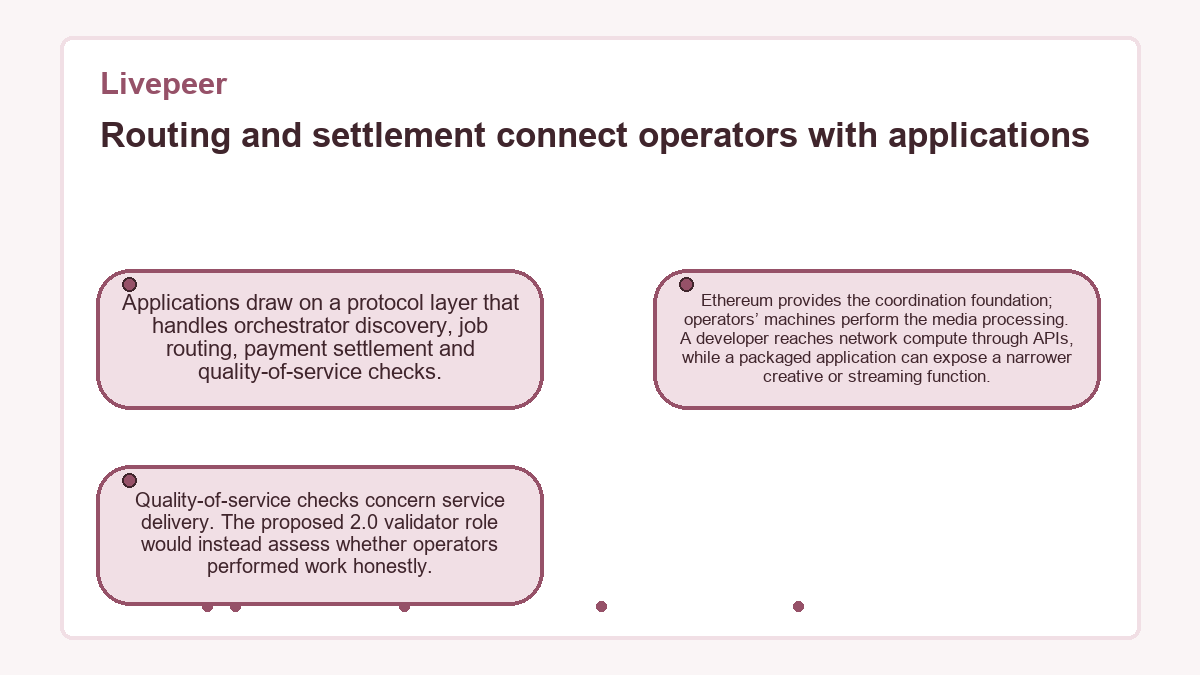
Applications draw on a protocol layer that handles orchestrator discovery, job routing, payment settlement and quality-of-service checks. Ethereum provides the coordination foundation; operators’ machines perform the media processing. A developer reaches network compute through APIs, while a packaged application can expose a narrower creative or streaming function.
Quality-of-service checks concern service delivery. The proposed 2.0 validator role would instead assess whether operators performed work honestly.
LPT issuance supports a separate reward stream
Processing fees compensate performed work, while LPT rewards distribute newly issued tokens. Orchestrators earn processing fees in ETH or stablecoins, and delegators can receive a share of that fee income.
The established protocol allocates LPT rewards in proportion to stake. An operator can receive a token allocation even when its share of paid jobs is smaller than its stake share.
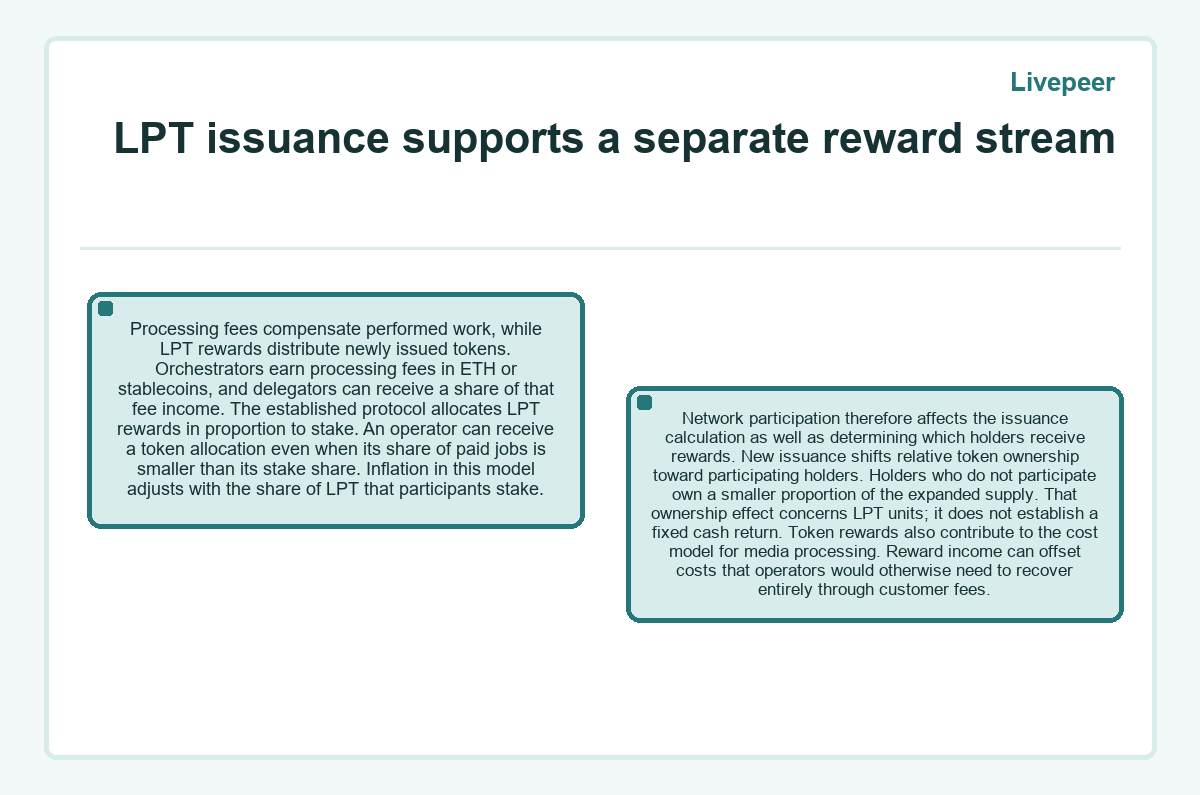
Inflation in this model adjusts with the share of LPT that participants stake. Network participation therefore affects the issuance calculation as well as determining which holders receive rewards.
New issuance shifts relative token ownership toward participating holders. Holders who do not participate own a smaller proportion of the expanded supply. That ownership effect concerns LPT units; it does not establish a fixed cash return.
Token rewards also contribute to the cost model for media processing. Reward income can offset costs that operators would otherwise need to recover entirely through customer fees.
What changes does the Livepeer 2.0 protocol proposal make?
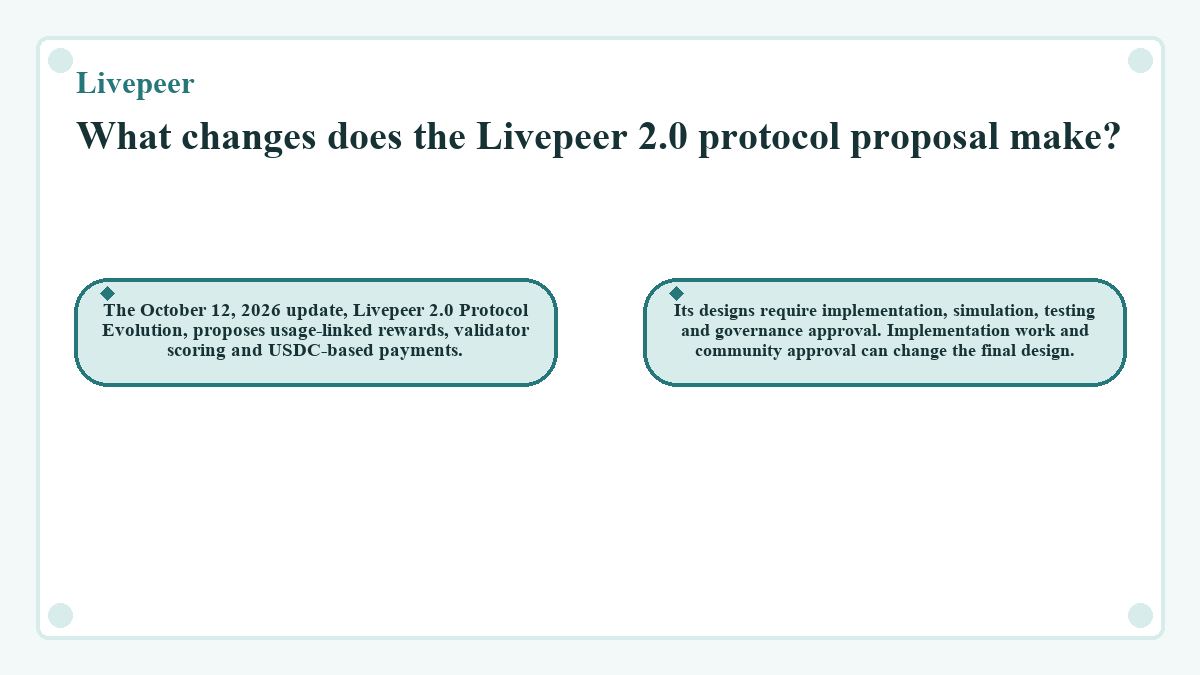
The October 12, 2026 update, Livepeer 2.0 Protocol Evolution, proposes usage-linked rewards, validator scoring and USDC-based payments. Its designs require implementation, simulation, testing and governance approval. Implementation work and community approval can change the final design.
Min-Fee-Stake links rewards to usage
Min-Fee-Stake, or MFS, would connect a node’s token rewards to both demand and stake. For each protocol round, the proposed MFS rule caps a node’s eligible reward share at the lower of its network-fee share and network-stake share. An idle node would consequently receive no token rewards under this model. Fees earned from processing work have no equivalent MFS cap. Additional stake can raise an active node’s reward ceiling when its stake share limits eligibility.
Validators assess honest work
The design would allow the top 33 nodes by total stake, including delegated stake, to register as validators. They would score operators from 0.0 to 1.0. The median score would determine how much of a node’s eligible rewards it receives. This scoring targets dishonest behavior, including fabricated fees, self-dealing and deliberately incorrect results. It serves a different purpose from a quality-of-service grade. Delayed reward claims would give scoring time to affect payouts.
USDC fees fund operators and LPT burns
The proposed launch split sends 50% of network fees directly to node operators. The other 50% buys back and burns LPT. These percentages apply to network fees, and governance could adjust the payment and burn parameters. The proposed schedule uses the existing issuance level as its starting point, then halves emissions every two years. Rewards that MFS makes ineligible would never enter supply. The schedule sets an issuance path; actual burning would follow fee activity.
Livepeer Agent connects prompts with media execution
Livepeer Agent provides a media-planning and execution layer that makes the network reachable from other agent tools. It organizes the models, editing operations and settlement involved in turning a prompt into video. The platform direction describes access through an MCP connector that other agent tools can call. This product layer is distinct from the underlying protocol’s proposed incentive changes. The wider 2.0 network direction includes API-connected services and non-GPU media capabilities, alongside GPU processing. Those media operations include captions, audio layering, clipping, resolution changes and overlays.
Products and protocol roles offer different entry points
Daydream, Frameworks and Embody package network capabilities for different media tasks. Those applications sit above the infrastructure and staking roles that support the network.
- Creative AI video points toward Daydream; live streaming points toward Frameworks; avatar work points toward Embody.
- API-based development draws on the network’s GPU-processing access when building an application.
- Supplying compute requires capable hardware and running the network software.
- Delegation commits LPT toward an orchestrator and carries the applicable protocol’s token-locking conditions.
Network-level support for a workload does not establish identical features in every application.
Useful questions about Livepeer
Can CPU-only providers participate in the Livepeer 2.0 network design?
The 2.0 network direction includes CPU-only nodes and API specialist nodes alongside GPU providers. Those roles could handle work such as clipping, captions, audio layering or overlays. This broader provider design appeared in the July 29, 2026 platform vision, separate from the established GPU-focused orchestrator role. It does not establish that every media task or model runs without a GPU.
When would node rewards become claimable under the 2.0 proposal?
The October 12, 2026 protocol proposal sets a delay of 7 rounds before rewards become claimable. That interval allows validator scores to affect rewards before an operator can claim them. The stated unit is protocol rounds, so it should not be treated as a promise of seven calendar days. This reward-claim delay is separate from the period for releasing staked LPT.
How long would LPT unbonding take under the proposed rules?
The October 2026 design extends the unbonding period to 21 rounds. That period concerns releasing stake, while the separate 7-round delay concerns reward claims. The proposal links longer unbonding to the cost of backing nodes that maliciously attack the network. These are proposed 2.0 parameters; the withdrawal period for an existing position follows the protocol version that holds its stake.
Does Livepeer 2.0 require a fixed LPT bond for node operators?
The October 12, 2026 protocol proposal would allow node registration without a fixed bond requirement. It would also remove the 100-node cap. The earlier July 29, 2026 platform vision included fixed per-node bonds, which explains the difference between the designs. Validator registration would retain a separate stake-based eligibility rule. These details describe the proposed protocol, with final implementation subject to approval.
Will the proposed LPT halvings automatically reduce token supply?
Halving issuance alone does not make LPT supply shrink under the 2.0 design. New issuance adds tokens, while fee-funded buybacks and burns remove them. The balance depends on network fees, token valuation and the rewards that remain eligible for minting. Governance-controlled burn parameters also affect that balance. The October 2026 proposal models burn-mint equilibrium over time without committing to a guaranteed date.